
Clinic Reflection: Your Mirror May Be Lying To You
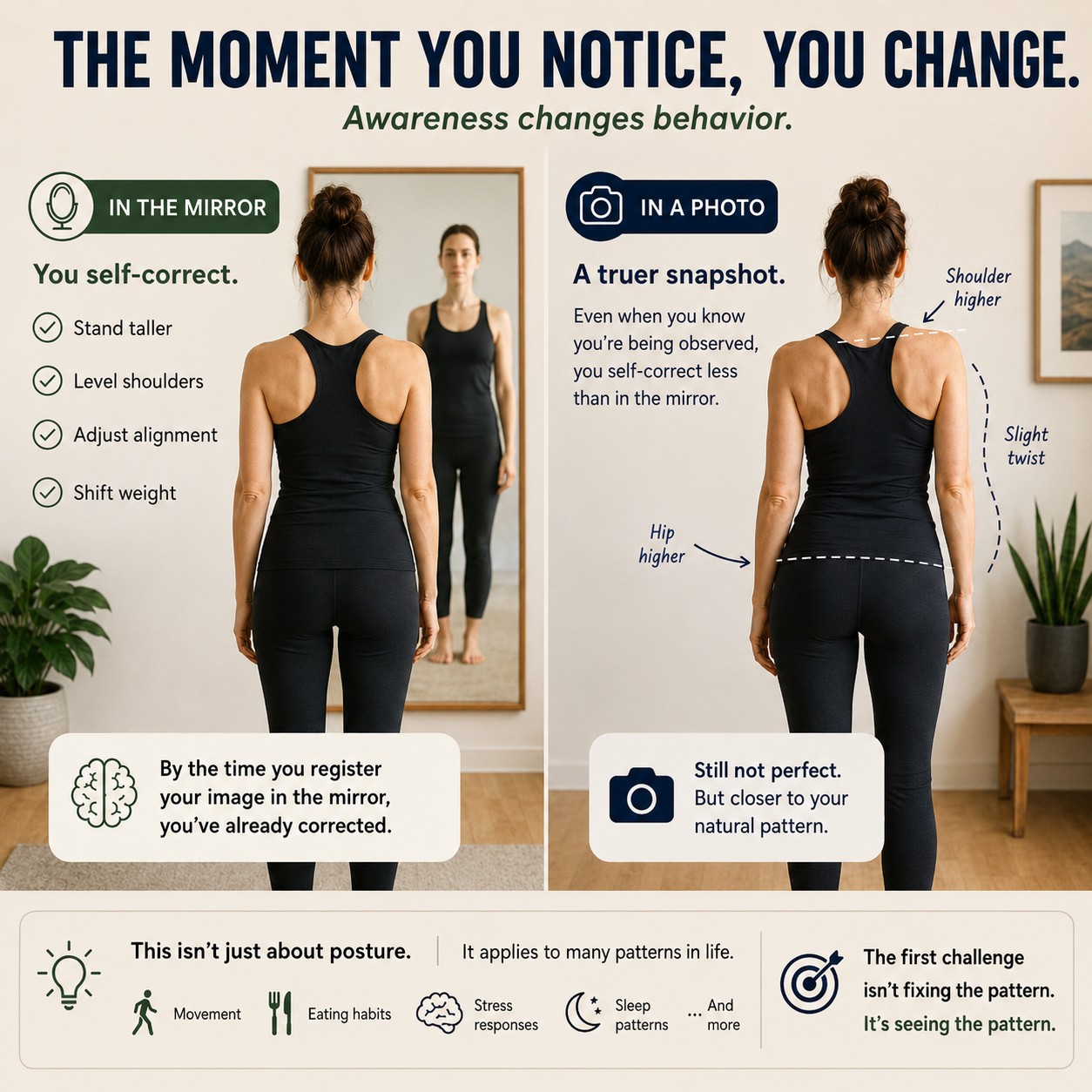
I hear this exchange with Dr. Eric pretty regularly: “Your left shoulder is sitting about an inch higher than your right”. And almost every time, the patient tilts their head and says, “Really?” Then they look for a mirror. But that’s not going to help.
Why? Because when you look in a mirror, your nervous system immediately goes into correction mode. So you genuinely don’t see it, because your body is actively correcting for it in real time. When you stand in front of a mirror, your brain receives visual feedback and sends signals to compensate. Muscles shift. Weight distributes. Your body quietly self-corrects toward “level”. The actual posture – the one that’s loading your joints, compressing certain discs, pulling certain muscles long and others short – is what shows up when your brain isn’t watching so closely.
Taking a photo helps. Sort of. When Dr. Eric takes a photo, you will be able to see the shoulder, the hip shift, the slight twist through the spine. The photo catches you slightly less compensated, because you’re not receiving live visual feedback to correct against. But even a photo isn’t the full picture. The moment you know you’re being observed, your nervous system will still make adjustments, just not as much. The most honest view of what your posture is actually doing all day is when you don’t know you’re being looked at.
Your body is a network of tension forces. When one area shifts or weakens, somewhere else has to pick up the load. A hip that’s been hiking up for years means the muscles on that side have shortened, the ones on the other have lengthened, the lumbar spine has learned to tolerate a rotation it wasn’t designed for, and structures higher up (ribcage, thoracic spine, even shoulder girdle) have arranged themselves around that new center of gravity. These usually start as smart adaptations that served a purpose once. An old ankle sprain, pregnancy, years of carrying a bag on one side, a job with repetitive action.
Structural work, adjustments, and soft tissue therapies are not just about moving bones and releasing tight tissues. They’re new shape shifting inputs. Every session is a nudge toward a new normal. Over time, the goal is that the compensated version starts to feel more awkward, and the more balanced version starts to feel more comfortable.
And this extends beyond your spine. Awareness is what moves a pattern from background noise to something you can address. That may be a hip that’s been hiking up for years or a stress response that fires before you’ve even registered a threat. The first step is not fixing the pattern. It’s seeing it.
That’s a big part of what we do at Nourisherpa. Whether Dr. Eric is showing you a photo of your posture, or we’re looking at labs together and connecting dots you didn’t know were there. The work starts with an honest picture of where you actually are, not the corrected version you present to the mirror.